Ballast Eductor & Bilge Eductor
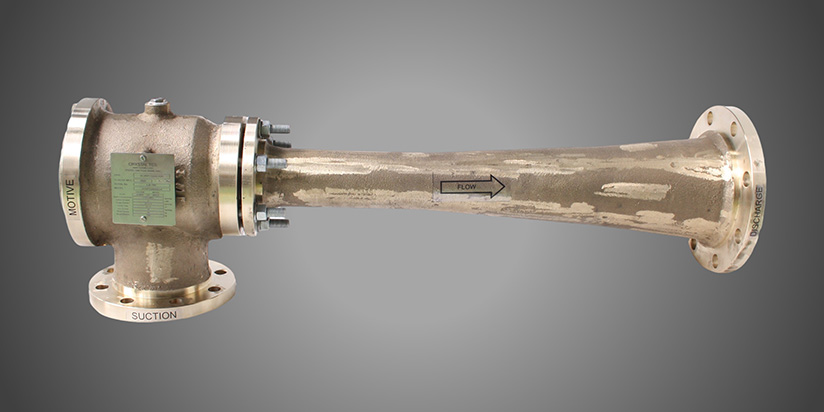
Ballast Eductors & Bilge Eductors are Liquid Eductors specifically designed for the Shipbuilding Industry. Based on the jet venturi principle the Ballast Eductor & Bilge Eductors are able to suck liquids in and pump them out of the outlet.
This ability is put to use in draining and filling of ballast tanks, draining and filling of bilge areas.
A Conventional Mechanical Pump requires Electrical Energy for its operation, similarly Ballast Eductors / Bilge Eductor require High Pressure Liquid flow, they utilize the energy stored in the pumped liquid. The Operation of Ballast Eductors & Bilge Eductors does not involve any moving parts and is completely dependent on the internal geometry. In most Installations Ballast Eductors & Bilge Eductors utilize Liquid from the Ballast Headers or from the vessel’s Fire Fighting system.
Our Ballast Eductors are successfully catering to de-Ballasting operations, pumping Crude and evacuating Bilges on Ships throughout the World.
Applications of Ballast and Bilge Eductor in Marine Environments
- Ballast Stripping : Stripping of Ballast Tanks
- Bilge stripping : Stripping of Bilge Area
- Crude Stripping For pumping Crude Oil from Crude Tanks
- Chain Locker Eductor : Stripping of Anchor Chain Storage Area
- Engine Room Eductor
- Cargo Oil Eductor
- Crude Oil Eductor
- Portable Eductor
Features of Ballast & Bilge Eductor
- Fluids Handled : Sea Water, River/Lake Water, Crude Oil
- Available in multiple configurations –Axial Suction Connection & Axial Motive Connection
- Self-priming nature of operation
- Ability to handle High Suction lifts upto 7m. Higher Lift options are also available
- Delivers Discharge Head upto 35m
- Works with a large range of Motive / Driving Pressures –3 bar(a) to 12bar(a)
- Total range distributed in more than 12 sizes : Large no. of sizes ensures optimum selection
- Available with multiple Flange Specifications: ASME B 16.5, ASME B 16.24, DIN 2501, EN 1092, JIS B2220
- Low-Capacity Models are also available with threaded Connections
- Adherence to Global Shipping Standards : ABS, DNV, IRS and others
- Available in multiple material of constructions :
| Ferrous | Non-Ferrous |
|---|---|
| Cast Iron | Tin Bronze |
| Carbon Steel | Nickel Aluminium Bronze |
| Stainless Steel |
Features of Ballast Eductor & Bilge Eductor
- Capacity to provide high suction lifts helps in stripping the bilges to the last litre with the help of our Bilge Eductors.
- Self-priming nature and high suction capacity of our Ballast Eductors makes Ballasting easier.
- Standardized Model range ensures low cost and fast delivery times
- Effective performance in a wide range of applications.
- Smaller size models also function as portable Eductors due to their low self-weight and availability of Threaded connections.
- No moving parts –Ensures excellent reliability, zero maintenance and a very long operating life.
- Silent Operation
- No risk of Sparking –Can be comfortably used in Hazardous Areas
Frequently asked questions (FAQs) about Ballast Eductors:
A ballast eductor is a type of eductor pump that uses a high-pressure fluid (typically water) to entrain and pump another fluid (such as seawater or ballast) from one location to another. It operates on the principle of the Venturi effect, where the high-velocity flow of the motive fluid creates a low-pressure area, drawing in and mixing with the entrained fluid.
A ballast eductor works by passing a high-pressure fluid (often seawater) through a nozzle at high velocity. This creates a vacuum or low-pressure zone around the nozzle, drawing in the fluid (ballast or seawater) from the surrounding area. The mixed fluid then exits the eductor through a diffuser, where pressure is recovered and the fluid is discharged.
Ballast eductors are commonly used in marine applications for transferring ballast water between tanks on ships or offshore platforms. They are also used in industrial processes where fluid transfer or mixing is required without the need for mechanical pumps or electricity.
Ballast eductors are simple in design, have no moving parts, and can handle solids or particles in the fluid being transferred. They are also easy to install and operate, requiring minimal maintenance compared to mechanical pumps.
One limitation of ballast eductors is their efficiency, which can be lower compared to mechanical pumps for certain applications. They are also dependent on a high-pressure fluid source (such as seawater) for operation.
Sizing a ballast eductor involves determining the required motive fluid flow rate and pressure drop across the eductor to achieve the desired flow rate and pressure for the entrained fluid (ballast or seawater). Factors such as inlet pressure, discharge pressure, and specific application requirements influence the sizing process.
Ballast eductors generally require minimal maintenance due to their simple construction and lack of moving parts. Periodic inspection and cleaning of nozzles, diffusers may be necessary to ensure optimal performance.
Ballast eductors are typically designed to handle liquids, such as water or ballast, and are not suitable for gases or highly viscous fluids. They can handle fluids with solids or particles as long as they do not cause blockages in the nozzle or diffuser.
Ballast eductors can vary in design based on the specific application and fluid transfer requirements. Variations include different nozzle configurations, materials of construction, and sizes to accommodate varying flow rates and pressures.